From the Workshop · Available Now

G scale auxiliary water tender,
built to run behind the Big Boy

A 3D-printed water tender in 1:32 proportions on 45 mm gauge, modeled on the pair of yellow 1937-built water cars that trail the Union Pacific excursion steam program. Sized and tested to run behind the MTH One Gauge 4-8-8-4 arriving this fall, or behind anything else big on your railroad. Sold as STL and 3MF print files, or as printed two-car sets.

A 3D-printed auxiliary water tender in G scale (1:32 proportions, 45 mm gauge), modeled on the Union Pacific 809 and 814 water cars and sized to run behind the MTH One Gauge Big Boy. Print files $64 (STL plus multicolor 3MF, all three builds, personal-use license). Printed two-car sets $425 with US shipping, cars 809 + 814 or 809B battery + 814. Coupler pockets take LGB-style and Bachmann-style couplers. Tested on 8-foot curves. Ships unlettered.

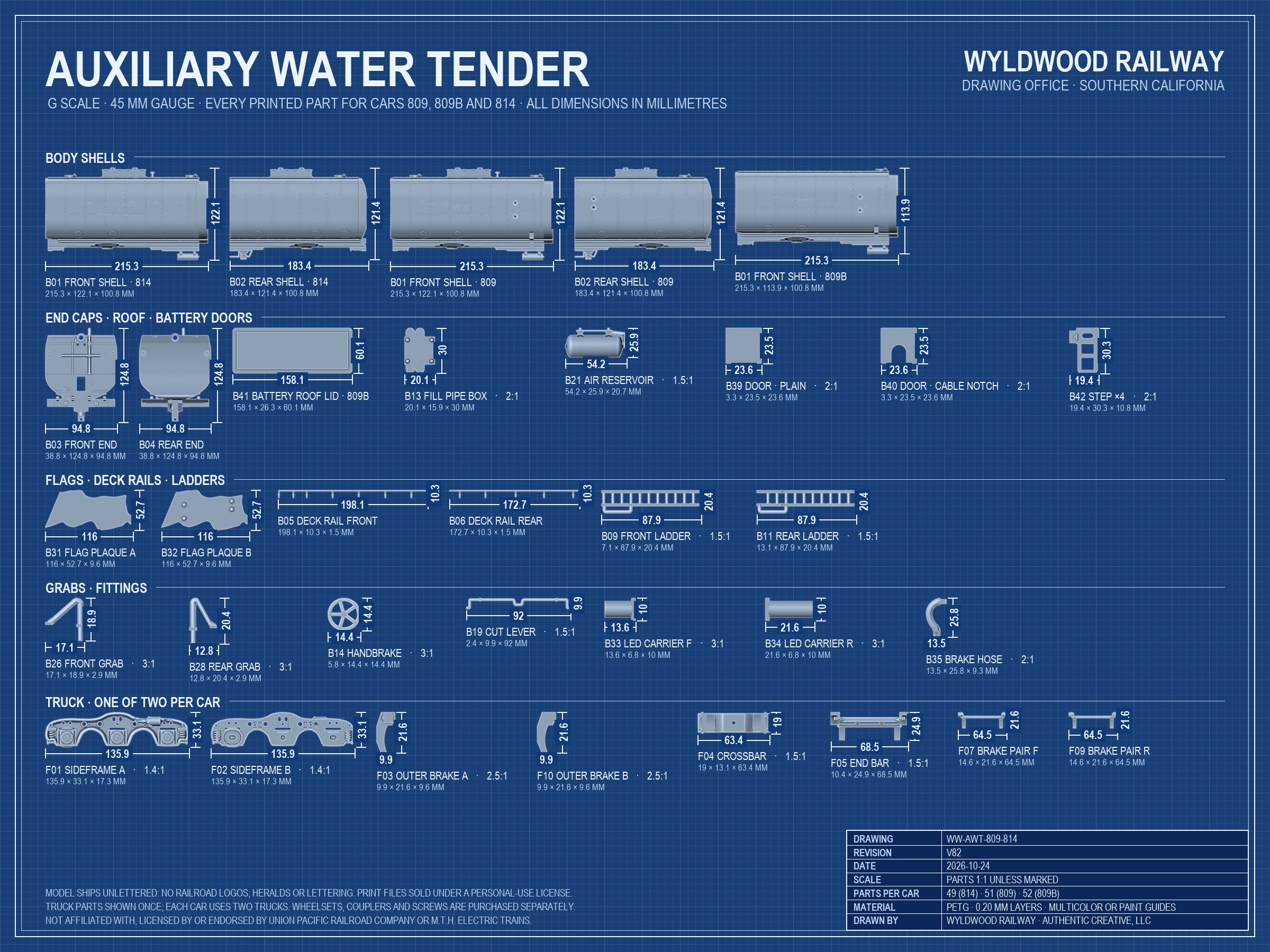
Blueprint-style drawing sheet of every 3D-printed part in the G scale auxiliary water tender for cars 809, 809B and 814, each dimensioned in millimetres
Drawing WW-AWT-809-814 · every printed part for both cars, dimensions in millimetres · rendered from the v82 modelClick to open full size

Turn it around

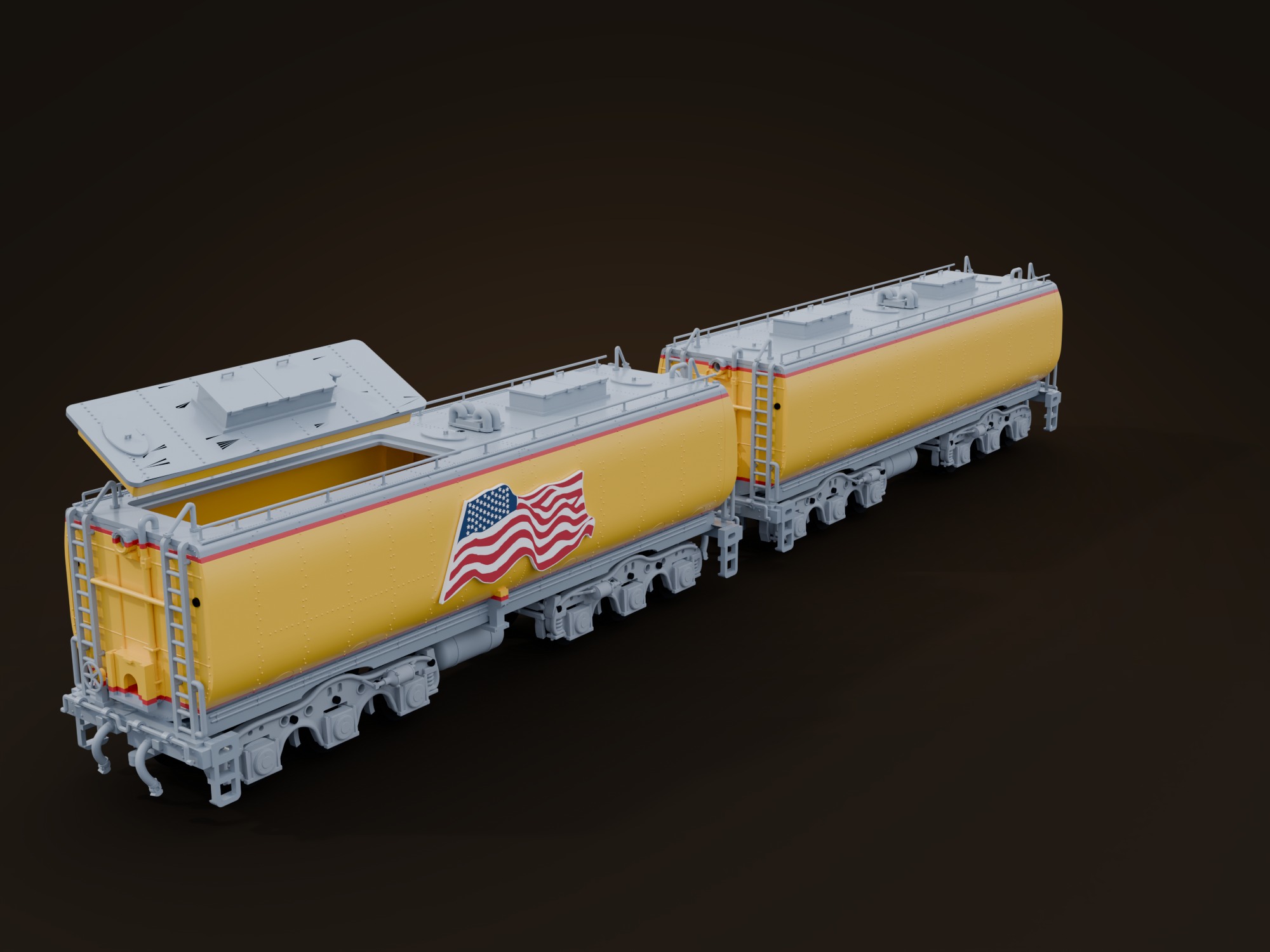
Road 809, standard roof

Flag plaques on both sides, side brackets, and the 809 side-beam pipe layout. The display car.

51 printed parts · model v82 · display geometry, simplified for the web. Wheels shown for scale and not included.

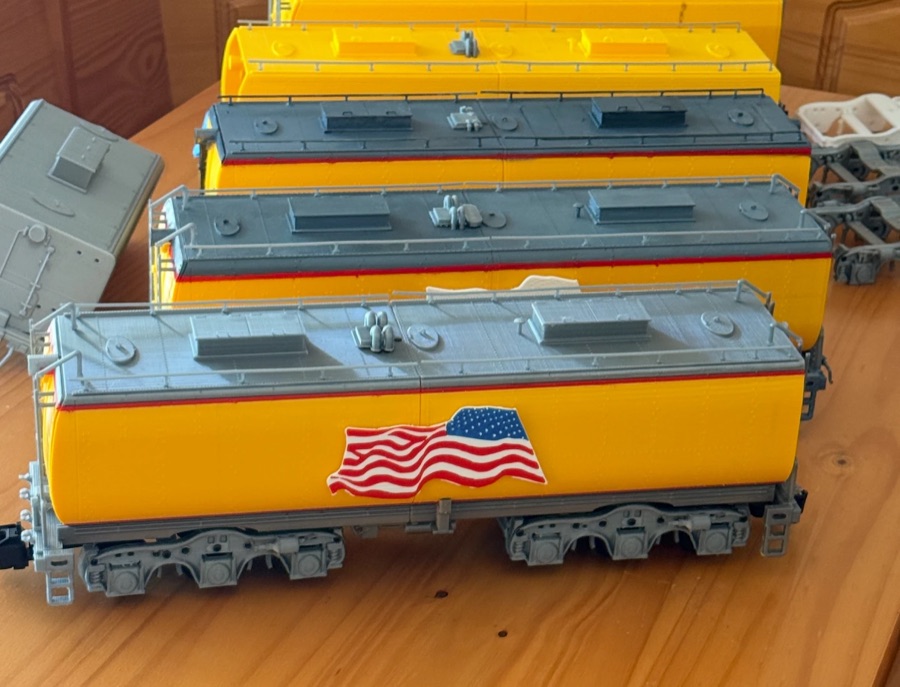
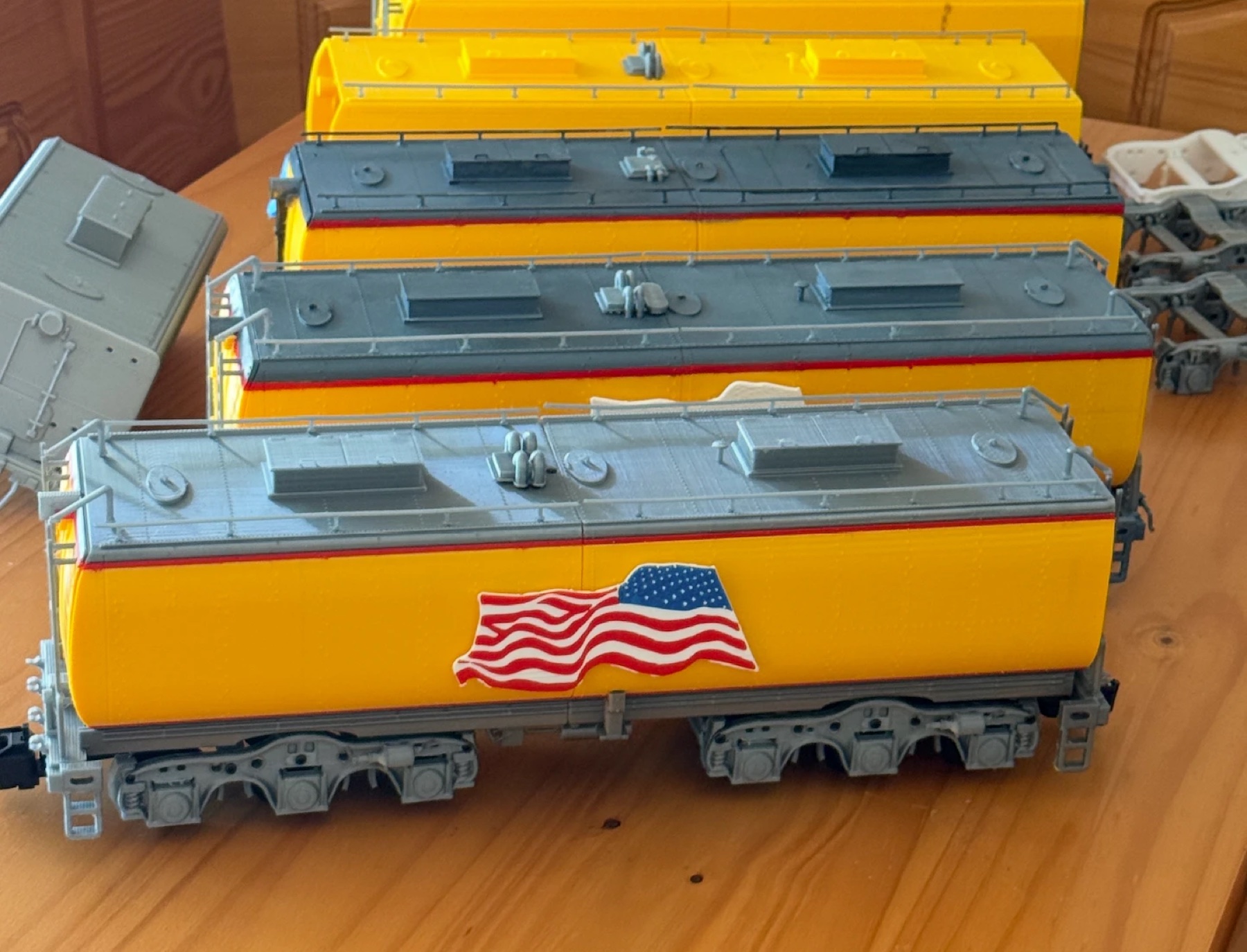
3D-printed G scale auxiliary water tender, car 809, in yellow and gray with red stripes and a flag plaque, with earlier test prints behind it
Off the printerCar 809 assembled, with earlier bodies from the modeling process behind it. Printed in multicolor PETG at 0.20 mm layers on a Bambu Lab A2L: yellow, gray, and red laid down by the printer, flag plaque in three colors, no paint and no decals.

Two road numbers, three builds

Road 809 carries the flag plaques and side brackets. Road 814 is the plain car. The 809 battery build swaps in a deeper roof hatch and a sliding front door so a large-scale RC battery pack rides inside for dead-rail operation. Pick one shell pair per car; everything else is shared.

Built to run, not just sit

Every release has been checked in CAD and in the slicer, and the running gear has been test-run on 8-foot curves with both plastic and metal wheels. Trucks are screwed, not glued, with capture rims that keep axles seated through switches. Coupler mounts accept LGB-style and Bachmann-style couplers.

Print it in one color or three

Each kit includes single-color STLs for every part plus multicolor 3MF projects that split the body into yellow, red-stripe, and gray volumes so a multi-filament printer lays the scheme down for you. The flag plaques get their own red, white, and blue split. Prefer to paint? The single-color shells carry shallow engraved masking guides for the stripes.

Unlettered by design

The model ships with no logos, heralds, numbers, or lettering, and was drawn from scratch by eye from photographs of the prototype. Finish it with licensed decals from your usual source, or leave it clean. We have ordered this 1:32 auxiliary water tender decal set from Circus Decals to try on the printed cars and will post a recommendation once they are on.

Road 809B · Dead-rail power

The tender that runs the engine

Road 809 was designed from the start around a large lithium RC battery. The 809B build is the version that uses it: the front shell gains a lift-out battery lid in the roof, and the front bulkhead gets a cable pass-through with a notched sliding door, so the pack rides inside the tank and its leads run forward to the locomotive. Couple it behind the MTH One Gauge Big Boy and the water tender becomes the power car for a dead-rail conversion. No track power, no pickups to clean, and the battery lives in the car that has room for it.

  • Lift-out roof lid, 10 mm locating lip, no screws or glue
  • Bulkhead pass-through 12 × 19.5 mm, with plain and notched door options
  • Pack and lead dimensions in the assembly notes; confirm yours before ordering

Three ways to get one

Download

Print files

$64
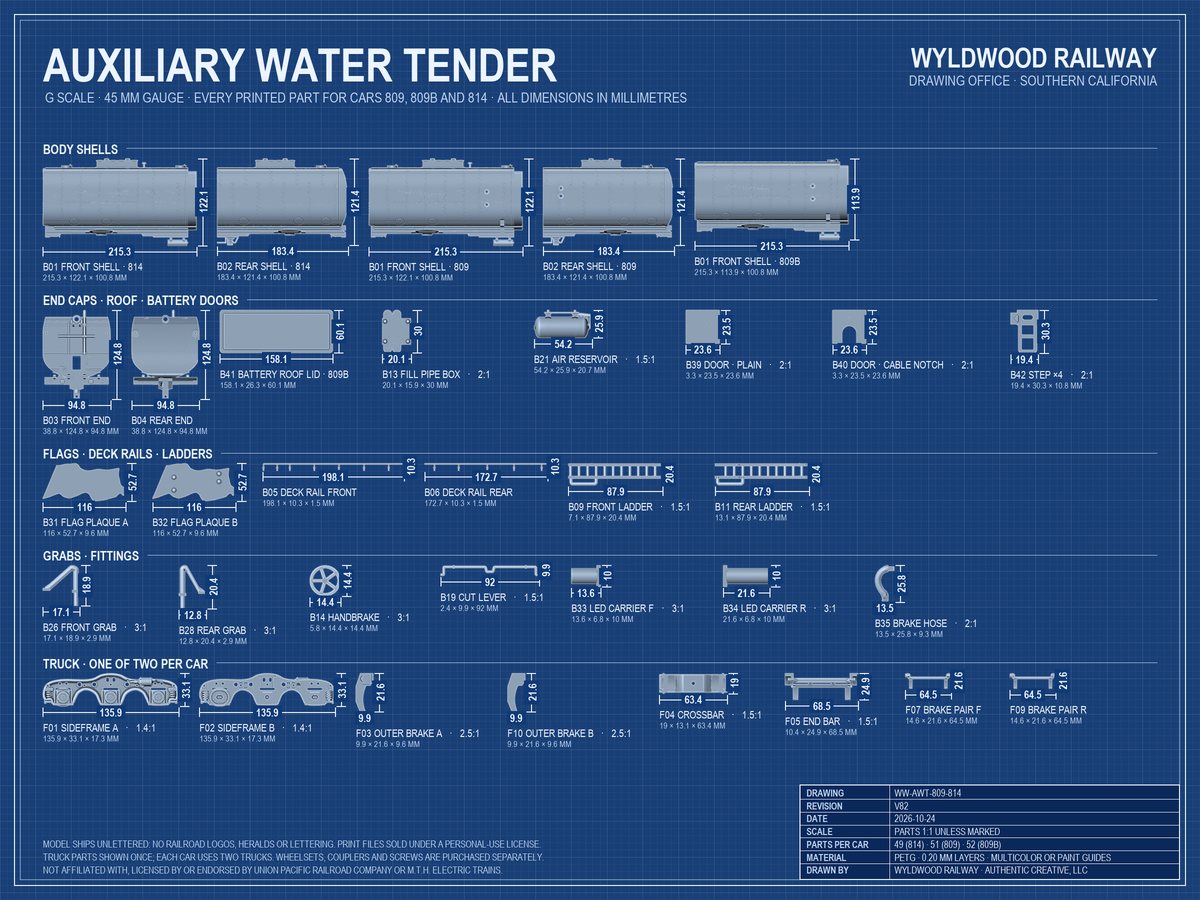
Blueprint-style drawing sheet of every 3D-printed part in the G scale auxiliary water tender for cars 809, 809B and 814, each dimensioned in millimetres

All three builds: car 809, car 809B with the battery roof, and car 814. Print as many as your own railroad needs.

  • Single-color STLs for every part
  • Multicolor 3MF body projects for 809, 809B and 814 (yellow, red stripe, gray) for multi-filament printers
  • Three-color flag plaque projects
  • Parts and quantities list, assembly notes, release notes
  • Personal-use license. Not for resale of prints or files.
Pre-order · two-car set

Cars 809 + 814, printed

$425 shipped, US only

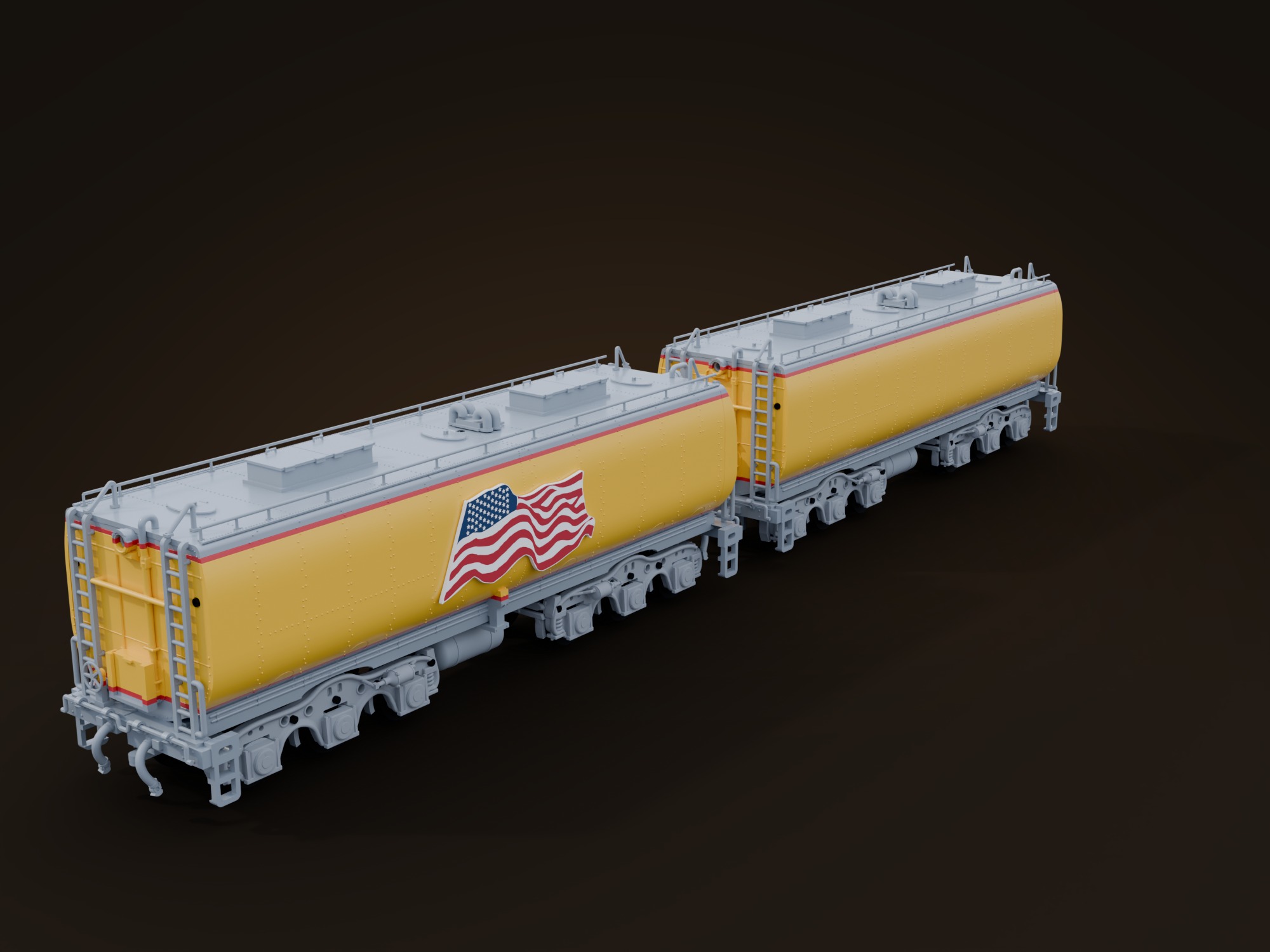
3D-printed G scale water tenders, cars 809 and 814, coupled, front three-quarter view

Both tenders printed in multicolor PETG, trucks assembled, body screws installed, flag plaques fitted on 809. The pair that runs behind the excursion engine.

  • Car 809 standard roof and car 814
  • Wheels and couplers not included
  • Ships unlettered
  • Shipping within the United States included
  • Pre-order batch; ship date confirmed by email
Details and questions →

Pre-order · dead-rail set

Cars 809B + 814, printed

$425 shipped, US only

3D-printed G scale water tenders, cars 809B and 814, coupled, with the battery roof lid of 809B lifted out

The same pair with the 809B battery roof: lift-out lid and bulkhead cable pass-through, ready to carry the pack that powers your locomotive.

  • Car 809B battery roof and car 814
  • Battery, wheels and couplers not included
  • Ships unlettered
  • Shipping within the United States included
  • Pre-order batch; ship date confirmed by email
Details and questions →

Specifications

Scale
G scale, 1:32 proportions, 45 mm gauge
Parts
49 (road 814), 51 (road 809), 52 (road 809 battery)
Hardware
Pan-head self-tapping screws for plastic: M2.6 × 6 mm for the two center-joint screws (top and bottom), M2 × 6 mm for everything else (six end-cap screws, eight per truck). Tested on the printed cars
Lighting
LED carriers front and rear for 3 mm round LEDs; LEDs, wiring and power not included
Printer
Printed on a Bambu Lab A2L; needs 215 mm of Z and about 205 mm on one axis (256 mm cube recommended)
Wheels
Not included. Tested with plastic and metal wheelsets
Couplers
Not included. Pockets accept LGB-style and Bachmann-style couplers
Minimum curve
Tested on 8-foot curves
Print volume
Tallest part 215 mm. Longest flat part 198 mm (brim recommended)
Material
PETG recommended
Files
STL for every part; multicolor 3MF body projects for 809, 809B and 814 (Bambu Studio); CSV parts list; Markdown notes
Files version
2026102482 (released 2026-10-24, model revision 82). Buyers always get the current version from their account page

Questions

Will it run behind the MTH One Gauge Big Boy?

That is what it was built for. It is proportioned to the 46-foot prototype at 1:32 and tested on 8-foot curves. MTH has not announced a water tender for the One Gauge line.

Is this an official Union Pacific product?

No. Wyldwood Railway is independent of Union Pacific and of MTH. The model carries no railroad marks, and lettering is up to you. See the note at the bottom of the page.

What is different about the battery version?

Road 809B replaces the front shell with one that has a lift-out battery lid in the roof, and swaps the plain bulkhead door for one with a cable notch. The pass-through is 12 by 19.5 mm. A large lithium RC pack rides in the tank and its leads run forward through the bulkhead to the locomotive. Check your pack dimensions against the assembly notes before ordering.

Do you sell wheels or couplers?

Not yet. The journals are cut for standard G scale axles with a 1 mm sideplay budget, and the coupler pockets take LGB-style or Bachmann-style couplers.

What printer do I need?

The cars were printed and test-run on a Bambu Lab A2L in PETG with a 0.4 mm nozzle at 0.20 mm layers, and the multicolor 3MF projects are saved with that profile. Minimum build volume: the body shells print upright and need 215 mm of height on a footprint of about 135 by 105 mm; the deck rails are 198 mm long and print flat with a brim, so you need about 205 mm along one axis or room to lay them diagonally. A 256 mm cube printer handles everything. Smaller beds can print all parts except the deck rails straight on. Multicolor needs a multi-material system (AMS or equivalent) and space for a prime tower; the single-color STLs print on any printer that meets the volume.

Does it have lights?

It is set up for them but they are not included. Each end has a slide-in LED carrier and lens seat for a standard 3 mm round LED with a flange up to 4 mm, held with a dab of adhesive. The carriers pull out from the end caps for replacement. Wiring, resistors and power are up to you; the 809B battery build gives you a pack to run them from.

What screws does it use?

Pan-head self-tapping screws for plastic. We have tested M2.6 × 6 mm for the two center-joint screws (one on the roof just ahead of the fill-pipe box, one underneath) and M2 × 6 mm for everything else: the six end-cap screws and the eight screws per truck for the crossbars and brake bars. Twenty M2 × 6 and a few M2.6 × 6 cover a car with spares. All body screws are removable for service. No glue is needed on the body joints or trucks; glue only the ladders and outer brake shoes as the notes say.

Where do I get decals?

The model ships unlettered. We have ordered the 1:32 auxiliary water tender decal set from Circus Decals to try on the printed cars and will post a recommendation here once they are applied. Any G scale decal maker that carries licensed Union Pacific lettering will also do.

What has and has not been physically tested?

Body, trucks, and running gear have been printed and run. The newest additions, including the three-color flag plaques and the latest ladder and end-pipe revisions, pass slicer checks and are in test printing now. Revisions land in the download as they are proven, and buyers always get the current version from their account page.

Wyldwood Railway

A garden railroad with the soul of a 1960s western backlot — somewhere in Southern California.